School attendance has to be one of the funniest parts in the kids memory as it is one time where teachers are in the room yet not teaching. Teachers calling out the names and every kid waiting for their turn. Some missed out on their chance, and some sitting so focussed to not miss out on their name.
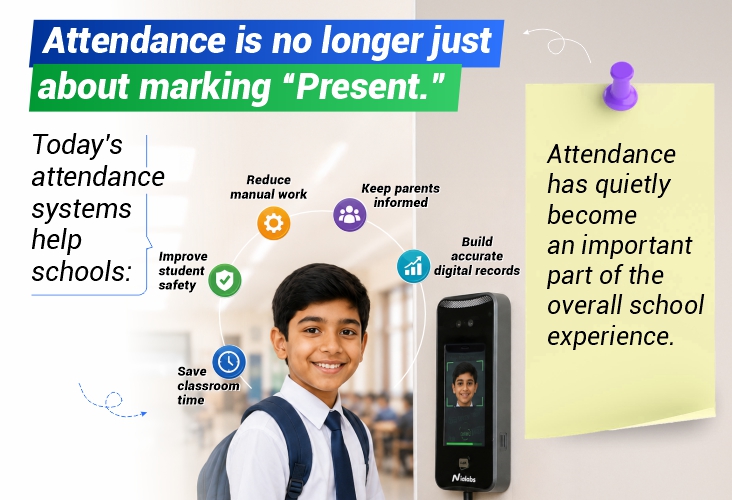
It was a relaxed moment for kids then, but today attendance is not just about marking in the register with whom all are present or absent. Today modern schools are introducing digital attendance systems so that they can improve the security of the students, reduce the administrative workload of teachers, and ensure there is accurate attendance maintained throughout.
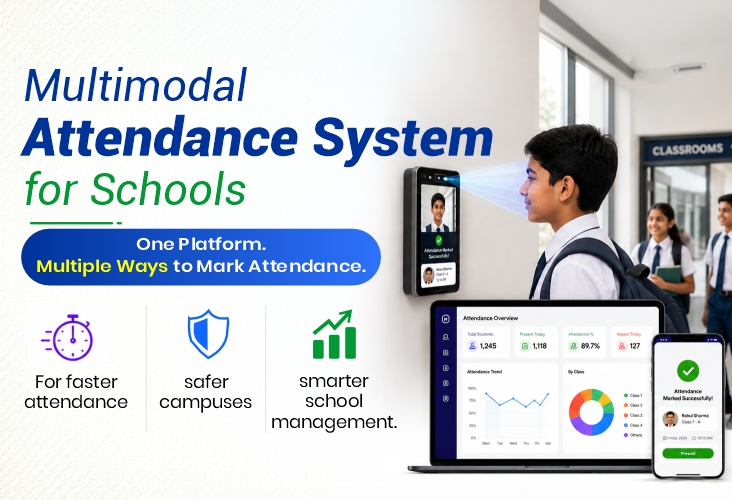
Today, schools are moving towards a smart attendance system so that they don’t get stuck anywhere if machine errors occur. So instead of relying only on RFID cards or only biometric verification, premises are now adopting multimodal attendance systems where multiple technologies are combined into one integrated solution.
And this blog is a detailed guide on what the two systems are, what are the differences between them and accordingly how multimodal systems are a better option.
But first,
Traditional attendance was simple but very time taking and somewhere consumes valuable classroom time. Because teachers have to spend several minutes everyday calling out names, maintaining their records, and preparing reports. And this is done for the entire academic year after which if you accumulate all those minutes it will turn into significant instructional time. And not just the time issues but traditional attendance also comes up with problems like human errors, there can be proxy attendance by students, delayed reporting that affects performance, administrative burden on teachers, and might be difficult to track if there are large student populations.
With digital attendance, schools solve these problems, making attendance tracking easier. So let’s look into the top 2 digital attendance tracking systems and see how combining both of them would be made effective.
The full form of RFID is Radio Frequency Identification where there are tags/cards that are used to read the data. And this data is read using the radio waves. So when a person puts an RFID enabled card near a reader, the reader, using the radio waves, automatically logs in the attendance without the need of any physical contact.
What’s happening in the background is when the tag is read by the machine, the reader machine emits a signal via the antenna, to which the tag responds by transmitting the unique identification number (UIN). The reader captures this UIN and sends it to the microcontroller for processing and then the data is processed, and accordingly the database is recorded which is then displayed on the screen.
So if every student is given an RFID-enabled ID card, the reader will automatically detect the card whenever they enter or leave the school premises and accordingly the attendance will be recorded. Not just with a card RFID Attendance System can also keep the record of faces, so there is Multi Face Recognition tracking device and Single Face Recognition tracking device. And the best part? It keeps in touch with parents too, so as the attendance is recorded, all the updates go to the parents too and they get notified through SMS or the app notification.
The entire process takes only a few seconds and with minimal intervention the security of the child is secured as now even the parents know when their children reach school and they’ve been there only.
A biometric attendance system also tracks attendance but by using the unique biological characteristics to identify individuals and record their attendance. It is built on identifying those unique traits that every individual possesses. It could be fingerprints, facial features, iris/retina patterns, palm veins, or voice prints. Mostly it is the fingerprints or facial features which are used to track attendance through this system.
The process in which it tracks the attendance is quite simple. There has to be an enrollment where the biometric sample, whether fingerprint or facial features, is collected and it is converted to an encrypted template. So now when the sensor has captured a raw biometric data, it extracts the unique features (the minute points for fingerprints or facial features) and then matches it with the stored template using the pattern-matching algorithms.
| Factors | RFID Attendance | Biometric Attendance |
|---|---|---|
| Speed | Generally faster because students only need to walk past the reader. | Requires fingerprint scans or facial verification and might take slightly longer during peak hours. |
| Ease of Use | Simpler for younger students | Requires proper finger placement, camera positioning, or scanning conditions. |
| Student Safety | Provides real-time parent communication so highly effective for student safety. | Secures student attendance but without real-time updates. |
| Attendance Accuracy | Mostly accurate attendance but another student can mark the attendance of someone if they have the card. | Provides the best identity verification and reduces the possibility where attendance can be manipulated. |
| Scalability | Great for large schools as it provides smoother movement during entry and exit times. | Can be an easy option for schools that have different timings for different levels or operates for lesser students. |
| Maintenance | Cards might get lost or damaged and will need to be made again | Devices might require timely software updates. |
It depends on just one thing.
OBJECTIVE!
If the primary goal is to provide student safety, have parent communication, get faster attendance, monitor the entry & exit timings, and integrate school transport too, then RFID attendance systems would be the preferred choice.
But if the primary goal is verifying identity accurately, eliminating proxy attendance completely, managing staff attendance thoroughly, then biometric systems are more suitable options.
To avoid the disadvantages of both the systems and keep the detailed benefits of both, the multimodal system of taking attendance is adopted.
In this attendance system, multiple attendance technologies combine into a single platform where schools do not depend on just one method. So a school can use RFID-enabled ID cards where they get quick entry, attendance is registered automatically, and parents have real time tracking. In the same system biometric authentication for teachers and staff can be used so that there is no chance of proxy attendance.
So with a multimodal attendance system, schools are able to improve security, simplify the attendance management, and have the best choice of verifying different users in the same campus.
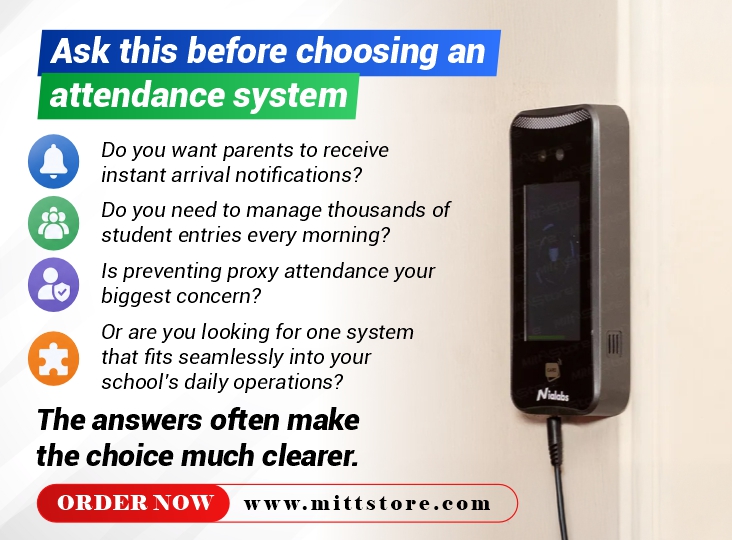
At Mittstore we have two Multimodal Attendance system options where face verification as well as features of RFID attendance is also available.
Multimodal attendance is generally preferred for student attendance as they are able to have a faster entry, quicker attendance, parents are notified, and tracking is better which overall improves student safety while keeping verified attendance for teachers and staff too.
Yes. RFID systems automatically record attendance when students pass designated readers, reducing manual errors significantly.
Yes. Many RFID attendance systems can instantly notify parents when students enter or leave school premises.
Yes. Many schools use RFID systems for students and biometric attendance for teachers and staff to gain the benefits of both technologies.