1. Improves Hand-Eye Coordination
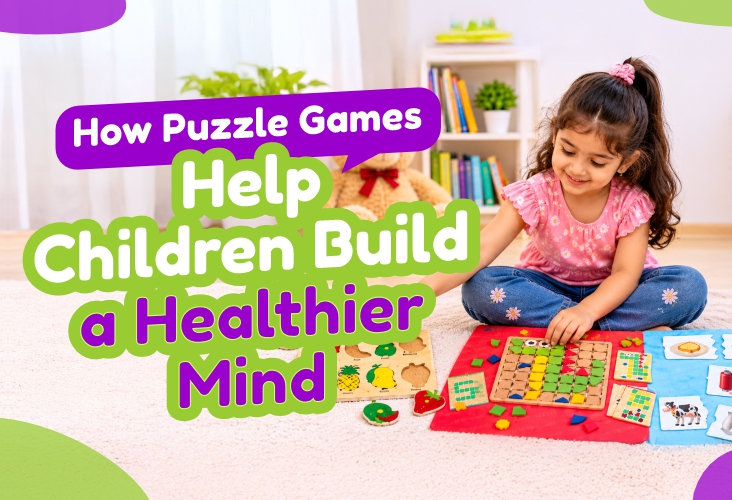
Puzzle games play a great role in improving hand-eye coordination. When a child reads or writes something, their eyes move across the page. Here, puzzles establish a connection between the brain, eyes and hands that work together to find the piece and fit the puzzle accurately, thereby improving hand-eye coordination.
2. Refines Cognitive Skills
Puzzles let children try different approaches and strategies to complete the game which helps enhance cognitive skills and analytical thinking. It also helps build spatial awareness, critical thinking and gross motor skills by imagining how shapes fit together and what must come next.
3. Strengthen Problem-Solving
Problem-solving skills directly influences a child’s ability to face life’s challenging situations. Puzzle games for kids offer a perfect ground for children to develop and strengthen problem-solving skills, thereby building self-confidence, fostering logical reasoning and enhancing critical thinking both in the game and in real life situations.
4. Boosts Memory
Puzzle games are an ideal way to boost memory because they require pattern identification, shape comparison and memory retrieval. Playing games on a regular basis can improve memory considerably and also helps combat age-related memory decline issues.
5. Develops Physical Skills
Other than mental abilities, playing puzzle games also helps develop gross motor skills, improves shape recognition, enhances body movement and fosters hand-eye coordination.
6. Instils a Sense of Accomplishment
Completing a puzzle game on their own instils a sense of accomplishment among children. Goal-orientation, decision making and creative thinking offer immediate effects and promotes a confident feeling among students.
7. Relieves Stress & Anxiety
Indulging your little one in puzzle games helps unwind stress and relieve anxiety. Since the mind is completely occupied while solving a puzzle, the child forgets daily worries for the time being and enjoy the moment.
8. Builds Concentration & Patience
Puzzle games require a lot of focus and patience as finding and fixing the right piece is a task. This helps develop a sense of perseverance, calmness and concentration among children.